
Top grades for Millfield’s new future facing qualification
Published by Millfield on Wednesday 2nd of September 2026
Millfield School’s pioneering ‘Baccalaureate style’ GCSE equivalent qualification has produced top grades for students.
Millfield developed and launched the new qualification in 2024, in partnership with Pearson Qualifications, to plug the extensive gap between traditional GCSE curriculum and what employers need and want in the future workforce.
Two years on, 73% of the first cohort of students received an A*, and 93% of the grades were A*-A!
The Project Qualification Baccalaureate (PQB) provides students with an opportunity to engage in student-led research on two topics of interest beyond the confines of the usual prescribed curriculum. The projects culminate in the creation of an essay or an artefact and the final grades are awarded after a university-style viva presentation and Q&A.
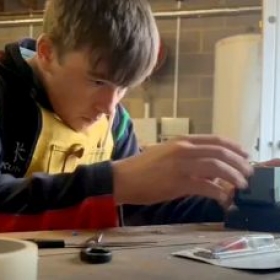
Year 11 Woody O'Brien earned full marks in both projects, alongside achieving six 9s, two 8s and an A in Additional Maths GCSE. He said: “Over the last two years, I've really enjoyed PQB as a subject, as it has allowed me to independently research topics that I am passionate about and wanted to expand my knowledge of, such as cricket and linguistics. The subject has also allowed me to develop my analytical thinking and time-management skills, and I believe that the more you put into the subject, the more you can get out of it. The level of independence and personal focus offered by PQB is particularly unique to the subject, and I'd strongly recommend it to those choosing their GCSEs."
Essays included; How are animals adapting to survive climate change in Europe? To what extent did the anthropause during the Corona Virus pandemic have positive environmental effects on the ocean, land and atmosphere? Is AI capable of making ethical decisions? Consumer versus Creator: Is the Attention Economy Harvesting Human Cognition? Safety breaches, manipulation of race results and drivers' heartbreak: Why was the 2008 Singapore Grand Prix so controversial? To what extent is nuclear power the right source of energy for the future in the UK?
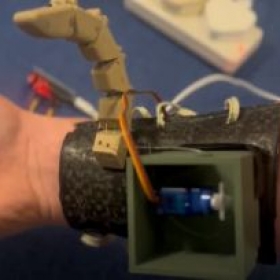
Artefact projects featured researching, designing and building a prosthetic finger mounted to a hand or arm, documenting the evolution of the Roman gladius by building 3 model handles and theory and practice of building a sturdy mobile MTB style ramp and Can I successfully build a rocket that launches off the ground and is there potential for parachute deployment?
The fifteen students who took the qualification as an option for the pilot were taught research skills including how to review large quantities of information, to determine the value of information from different sources, to discern what is real and what is fake and to understand the benefits and limitations of AI.
35 students have since chosen to study the qualification with more expected at the start of the academic year in September.
The qualification is led by Head of Academic Culture Bea Priest and is structured in a similar manner to the Extended Project Qualification (EPQ) available to older students in Sixth Form, allowing greater breadth and variety. The Year 10/11 qualification introduces independent learning skills at an earlier age to better prepare students for future academic endeavours.
Gavin Horgan, Millfield Headmaster, said: “Millfield has a history of disrupting educational norms and we are delighted to have pioneered this new course, as an alternative to a GCSE, and to see how well the students have excelled in it. It demonstrates the power of students being given autonomy in directing their own learning pathway and sparking their curiosity and passions, something that the education system in the UK is severely lacking. This qualification explicitly teaches research skills that will prepare them for A levels, EPQs and beyond into university. It has never been more important for students to develop critical thinking skills and engage with real-world content with rigor and integrity.”
The qualification will give high-achieving academic students a significant edge when applying to competitive university programmes as they will be able to discuss their unique projects during the admissions process. It will also assist those choosing to do an EPQ at Sixth Form.